
SEO is dead! This has long been a saying used by skeptics who think SEO doesn't matter. However, it is true the opposite. Google (mainly) and Bing (somewhat) still dominate the digital world, and it doesn't look like that's going to change in the near future. And this article looks at a way that will change search as we know it.
Let's start with a smaller question first. How would you use Google to find the weather forecast if you:
The article was revised and updated in May 2026.
- used a computer with a keyboard,
- were they talking to their smartphone?
If you're like most people, your answer to a) is "the weather today". For b), it would probably be "What's the weather like today?".
Without realizing it, you have different habits for text and voice searches.
Search has finally come of age. That time you hoped for a better way to understand intent and better personalization finally is coming and natural language will be its key.
Voice assistant technology will change marketing as we know it.
What is meant by voice search
When we say "voice search," we mean a smartphone or computer that has a built-in digital personal assistant that serves as a voice entry point, such as Google Assistant or Siri.
In most cases, if you use a personal assistant and activate it with your voice, you will do some searching. And that's the element of voice command that this article deals with.
Who uses voice search?
Most of you reading this article have probably already used voice command or seen someone use it.
In one of the few studies in this area, Thrive Analytics published compelling numbers about people using digital personal assistants in the US.
photo source: moz.com
As we can see, it is mostly used by the young generation. But what is surprising is that many elderly people also use it. Apparently, they are tired of looking at small screens and tapping letters that are barely visible. In short, voice search is easier.
Currently, the accuracy of voice recognition is at the level of 90-95%, which is an impressive number compared to 75% a few years ago. Therefore, there is no doubt that the use of voice search will only grow in the coming years.
How do we use voice search?
This is an important question. From the graph below, from the Northstar Mobile Voice study, we find that it is about asking for directions.
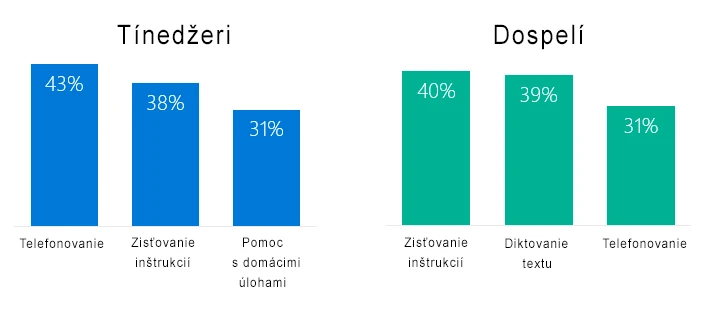 photo source: moz.com
Are most of us lost? We probably need an assistant to help us improve our lives. Google envisions the future of voice search as a comprehensive mobile assistant that will help you with your daily life while you can focus more on the things that matter. This is quite interesting and probably possible.
Microsoft also has its own assistant, Cortana, which came with Windows 10 in 2015. What is the most common question people ask her? Surprisingly, it is a question of “Who is Bill Gates?," as people expect a funny answer. To clarify, early reports of Cortana claimed that after the question "Who is your photographer??," followed a funny answer about Bill Gates.
But that's not how Cortana works. She means it and this is her answer:
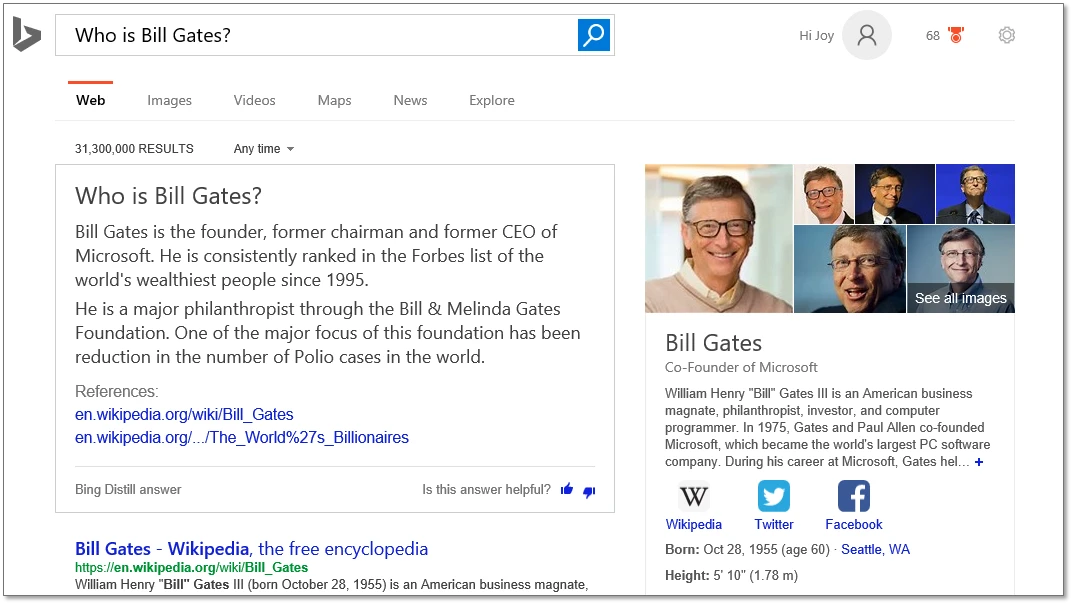 photo source: moz.com
How fast voice search is growing
1/3 of the search phrases for Cortana come from voice.
We can't tell which phrases in Bing are text and which are voice. However, we can tell which phrases searched through Cortana come from text or voice because Cortana is part of the Windows 10 operating system.
photo source: moz.com
This data is from November, just 3 months after the launch of Windows 10, and 33% of phrases come from voice. That is impressive.
We all know that voice search leads to SERPs. But more importantly, some voice searches can lead to results that also show ads from AdWords.
Patria sem aj vaše výsledky? To by ste mali zbystrieť pozornosť.
How voice search differs from text and what you can do about it
So we already know that voice search is being used and that it will continue to grow, so let's now focus on the 5 most important ways that voice and text differ from each other.
-
The length of the search phrase
The first thing we have to think about is the length of the search phrase. It must be different compared to the text. Let's compare data from a Cortana search.
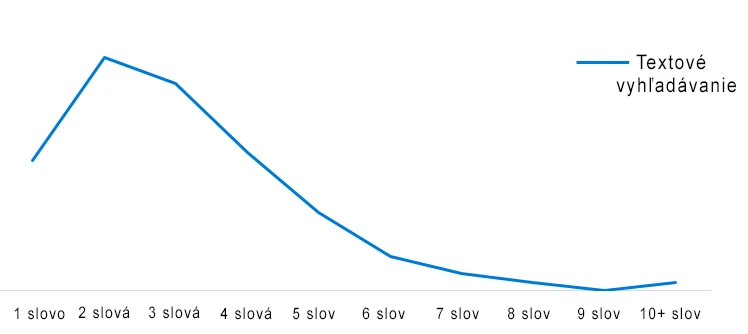 photo source: moz.com
Not surprisingly, the length of the text phrase is quite short, around 2 words. Here we use computer language, which is not a sentence, but the most direct way to express our intention.
Next, let's look at phrase length for voice search:
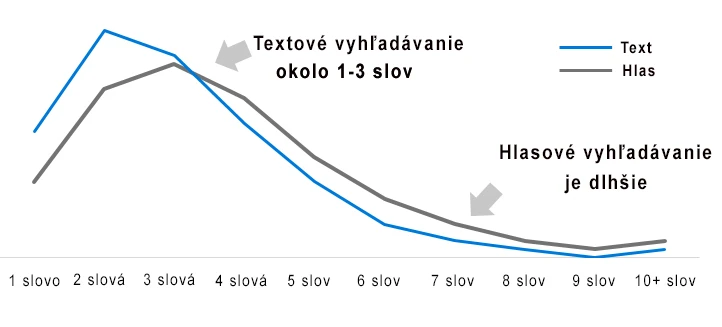 photo source: moz.com
What we can see is that the successful voice search that gets the most results, impressions and clicks is 3 words long.
That's a bit of a surprise. One would expect that a voice search would be significantly longer than a text search. On the other hand, these are only the first results, so we can expect progress in the next period.
The younger generation like children are used to using natural language. Here is a great example that was presented at SMX Munich showing a voice search done by a little girl.
photo source: moz.com
Note the level of choice and specificity. This is how we will search everyone.
Quick tip:
You probably target 1-2 keywords for your website, such as:
- Bahamas,
- Bahamas by air,
- bahamas vacation,
- bahamas vacation,
- Bahamas travel.
Test longer, friendlier keywords like:
- the price of a flight to the Bahamas,
- Bahamas vacation info,
- the most affordable vacation in the Bahamas,
- the cheapest trip to the Bahamas,
- Bahamas travel guide.
While longer phrases can help you rank for these keywords, it doesn't necessarily convert and therefore may not cover the way people search using voice.
-
Phrases with questions
Voice search differs from text search by using phrases with questions.
When you type something into Google, you use computer language, such as "Bahamas the best vacation". When you use voice search, you will use your own language, like "Who has the best deal on a Bahamas vacation?".
Quick tip:
Try adding some relevant question key phrases to your keyword list. For a company selling Bahamas vacations, some relevant questions might be:
- How much are flights to the Bahamas?
- Where can I find information about a vacation in the Bahamas?
- What's the best deal on a Bahamas vacation?
- When is the best time to vacation in the Bahamas?
-
Greater incentive to convert
This may be the most important difference, as natural language leads to greater conversion intent.
If someone were to search for the phrase “digital camera," you wouldn't know if he wants to buy a camera, repair it, or is just looking for a photo of the camera. This is where natural language plays a role.
The type of question that is asked can indicate the level of interest:
photo source: moz.com
This has a real impact on bidi and creativity. You can bid more for question phrases with the highest chance of conversion, such as "Where is the nearest restaurant?”.
-
Emphasis on local SEO
Mobile voice search is 3x more likely to be more local than text search. This is closely related to the fact that most smartphone searches are local.
Therefore, local businesses should pay attention, as voice search may become the most important way their customers search.
Quick tip:
If you are a local business, it is important that you change your strategy because this way you can get more customers.
Be better with keywords relevant to your search:
- urban districts that need to be highlighted, such as "old town"
- how do people describe your neighborhood in the local dialect?
5. More quick responses and actions
Voice search will show more quick answers in search results. This is because question phrases will be more relevant to local businesses, such as a question like "Where is the nearest car rental office?”.
These are clearly local search phrases where ads appear along with the search results. You can see reviews, phone and the possibility of booking. Users don't need to enter your website to complete their intent.
This will have a strong impact on community-run sites like TripAdvisor, where you'll need to responsibly fill in your opening hours, contact details and watch people's reviews.
Quick tip
As a local business, make it a priority to position your website and be active on relevant sites. These pages are highly influential in search.
How to proceed?
Looking further into the future, one thing is certain. We will adapt. We adopt voice search. In addition, voice commands will be further expanded with the help of IoT (Internet of things), which will include home appliances.
We know from history that we have proven time and time again that we can adapt. Think about your first moments when you were learning how to use a computer. Or when you got your first touchscreen smartphone. In short, the ability to adapt to conditions is within us.
photo source: droid-life.com
cover photo source: twitter.com
source:
https://moz.com/blog/how-voice-search-will-change-digital-marketing-for-the-better