We've all been there. A LinkedIn demo shows off an AI chatbot that can do 'everything'. You eagerly upload your online store exports, PDF manuals, and support rules. The first week feels like magic. A month later, you discover the chatbot promised a B2B client a non-existent discount, recommended an out-of-stock product, and walked a new support rep through a process from 2022.
The result? Nobody on the team trusts it, and the project dies a quiet death.
The issue isn't the AI technology itself. It’s that you’ve built a powerful engine (AI), but forgot to provide it with a map and fuel (high-quality, structured data). At vibration.sk, through building complex e-commerce solutions and B2B portals, we've learned that AI without the right foundation is nothing more than an expensive toy. That foundation is the Company Second Brain.
What the Company Second Brain is (and what it definitely isn't)
When most companies hear 'AI powered by corporate data,' they essentially picture a dumping ground. They take their Google Drive files, a PIM system export, toss them all into a single folder, and plug them into ChatGPT or Claude Code.
This is the rookie approach:
- Outdated e-shop data mixes with the new.
- The system cannot distinguish between B2B and B2C logic.
- The AI "hallucinates" answers if it can't find an exact fact.
Company Second Brain (according to vibration.sk standards):
- A distilled and maintained core of know-how – organized by how systems read it, not by how your copywriter created it.
- A layer of live integrations – instead of copying stock data into the AI, the AI queries it directly from your ERP or CRM in real time.
- Agents with narrow specialization – one agent handles product returns, another helps sales reps with B2B pricing.
Your only competitive advantage? Your context.
Deploying or integrating AI today takes almost no time and costs a fraction of what it did a year ago. The one thing your competitors can't buy, however, is your context.
How exactly does your reverse logistics work? Why do VIP B2B clients choose to buy from you? What are the technical specs of your most complex products? This is the real goldmine. AI models are cheap, but high-quality context is extremely expensive and difficult to maintain. The Company Second Brain is the infrastructure that turns this 'tacit knowledge' (often locked inside the heads of your top performers) into a structured database.
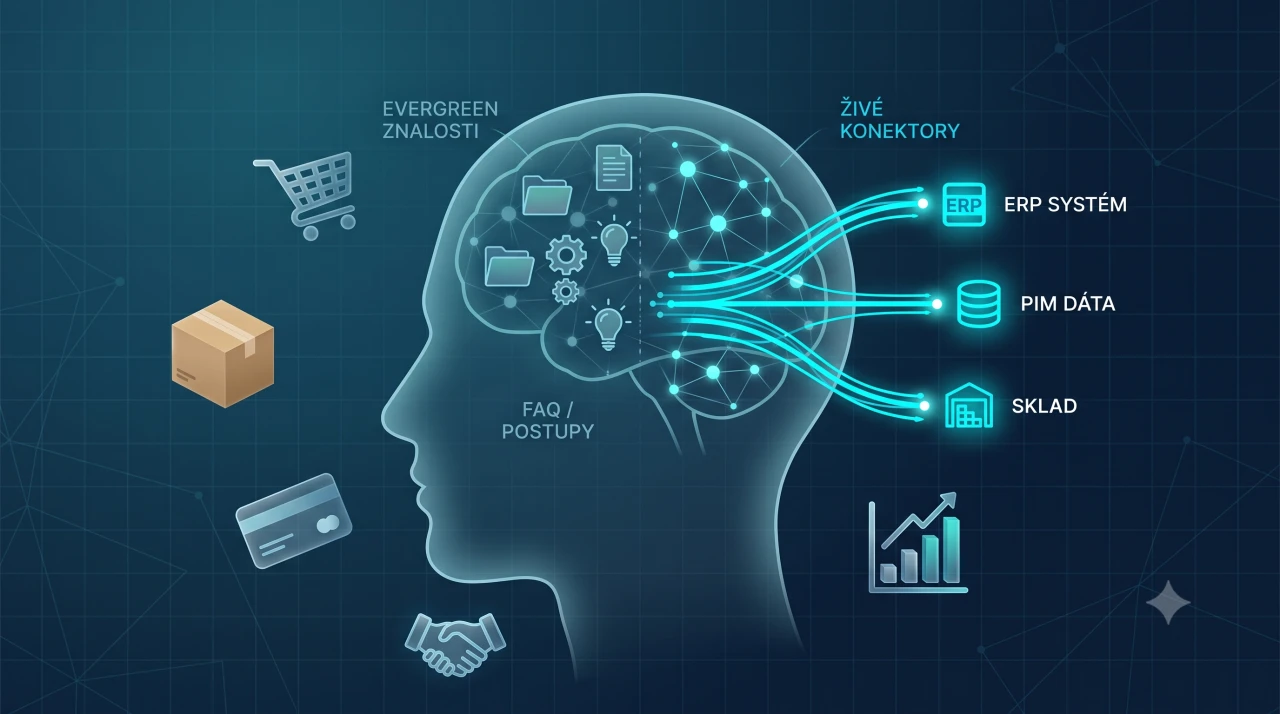
The golden rule of data architecture: Store evergreen knowledge, integrate live data.
As tech leaders in e-commerce development, we see the same fatal mistake time and time again: companies trying to train AI on their live inventory.
Forget that right now.
A well-designed Second Brain architecture must strictly decouple:
- Evergreen knowledge (Static core): This includes your brand identity, tone of voice, return policies, and FAQs. These elements change infrequently and belong strictly in the core.
- Live data (Dynamic integration): Real-time inventory levels, custom B2B pricing for specific partners, and order statuses. This data does not live inside the AI. Instead, we build connectors (API integrations with your ERP/PIM) that allow the AI to query the current state in milliseconds. If a product sells out, the AI knows about it instantly.
This is what stability and quality look like in practice. Without this structural separation, your AI will confidently lie to your customers.
The Maturity Model: From Chaos to 'Always-On' E-commerce
Not every online store needs 'Skynet-level' AI right out of the gate. At vibration.sk, we take an agile approach. We design the architecture around your most pressing pain points.
- Level 0 (The Dump): Files thrown into AI. It works in a demo but fails in real operation. (We do not do this).
- Level 1 (Structured Map): A clearly defined knowledge tree structure from which internal agents draw to onboard new people into the company.
- Level 2 (Semantic Search): For e-shops with a huge portfolio. The AI doesn't search by keywords, but by meaning (excellent for intelligent web search or sorting thousands of support tickets).
- Level 3 (Always-On Connections): Full integration. A B2B client asks for a specific setup, the AI agent analyzes their purchase history, queries the ERP for their individual price list, and creates a cart proposal.
The Acceptance Test: 20 Tough Questions
Our transparency means we don't promise miracles. Miracles, after all, are impossible to measure. That's why, before going live, we define what we call an Acceptance Test.
You and your team will compile the 20 most complex, real-world questions from your day-to-day operations. For example:
- "What is the difference between generation 2 and 3 of this product, and can we deliver it to client X at their contracted prices by Tuesday?"
- "A customer returned this specific product opened, what is our procedure according to the new rules?"
- "How many orders did I have in May 2026, and break them down by status (new, paid, shipped...)."
Until the Company Second Brain and its agents can answer these questions flawlessly using your actual business data, the system doesn't go live. These questions serve as our ultimate quality benchmark.
How to turn this into a competitive edge this very quarter?
Don't overhaul your entire business from scratch. Instead, identify a single bottleneck that’s slowing you down today—whether it's writing product descriptions with complex technical specs, or the initial triage of customer support tickets.
At vibration.sk, we aren't just another dev shop. We are your strategic partners. We will build you a robust e-commerce architecture built to scale, seamlessly integrate your systems, and deploy an intelligent layer that actually saves your team hundreds of hours every month.
Forget AI toys. Let's build an engine that doubles your online store's efficiency. Get in touch, and we’ll kick things off with our 20-Question Test.