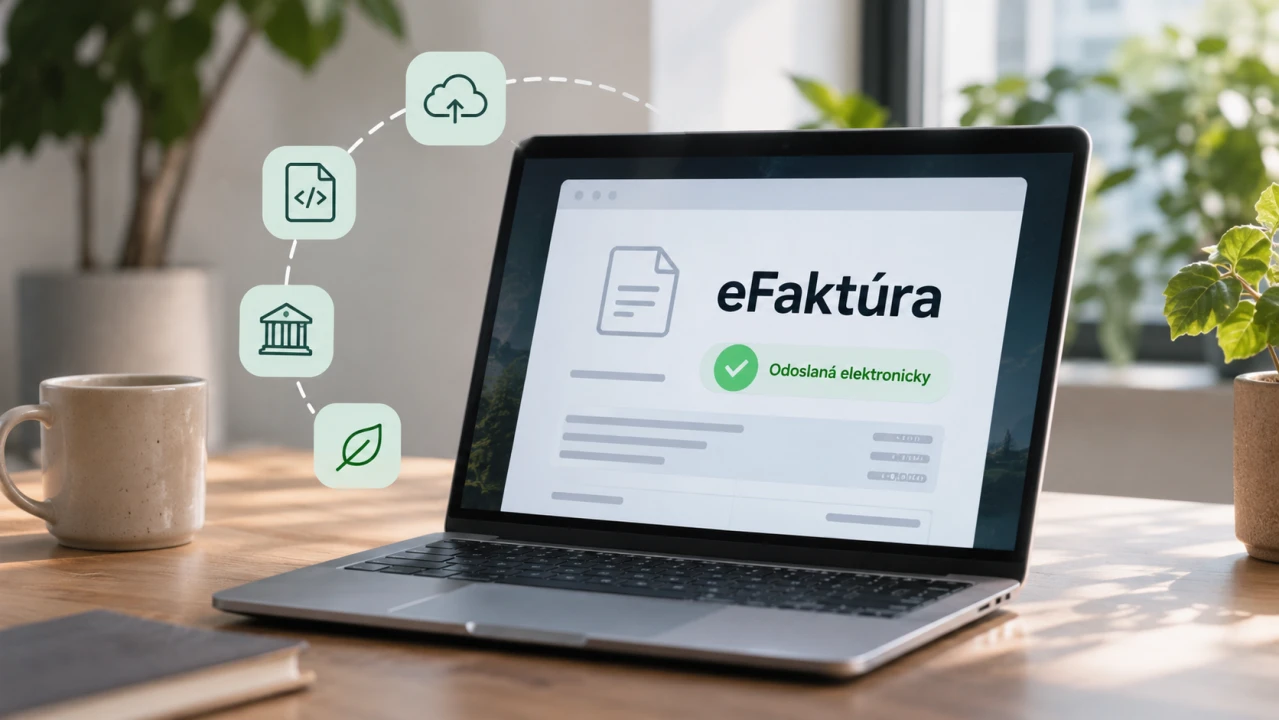
Invoicing in Slovakia changes in six weeks. From 1 January 2027, VAT payers must issue invoices to other businesses and to the public sector as e-invoices: structured XML files sent over the European Peppol network. A PDF sent by email will no longer do. For a B2B e-shop, this changes what happens after every order. And a B2C e-shop is affected too, the moment a company buys from it.
What changes on 1 January 2027
Mandatory e-invoicing is introduced by amendment No. 385/2025 Coll. to the Slovak VAT Act, passed by parliament in December 2025. In practice, it brings four changes:
- A different format — an e-invoice is an XML file following the European standard EN 16931 (Peppol BIS). A PDF, a scan or a photo of an invoice is not an e-invoice.
- A different channel — the invoice travels over the Peppol network through a certified delivery service provider, known in Slovakia as a “digital postman”. Email as a channel for B2B invoices is over.
- Reporting to the state — when sending the invoice, the digital postman also passes selected invoice data to the Slovak Financial Administration. The customer and the tax authority see the invoice practically at the same time.
- Peppol ID — every business on the network has a unique identifier that works much like an email address for documents. In Slovakia, the key piece of data is the tax ID (DIČ).
Who it applies to
The obligation to issue an e-invoice lies with the supplier who is a VAT payer. But every business, including non-VAT payers, must be able to receive one. A quick overview:
| Situation | E-invoice from 1 Jan 2027? |
|---|---|
| VAT payer invoices another business in Slovakia (B2B) | Yes, mandatory |
| VAT payer invoices the state or a municipality (B2G) | Yes, mandatory |
| VAT payer sells to a consumer (B2C) | No, document as before |
| Simplified invoice, e.g. an eKasa receipt up to €400 | No |
| Non-VAT payer receives an invoice from a VAT payer | Must be able to receive it |
| Non-VAT payer issues an invoice | Only from 1 July 2030 |
| Supply to another EU country | Only from 1 July 2030 |
The period from 1 January 2027 to 30 June 2030 is transitional. From July 2030, the obligation extends to all taxable persons and to cross-border supplies within the EU. You can join voluntarily and try everything out right now.
What it means for an e-shop
Most e-invoicing guides deal with invoicing software, where an accountant clicks “Issue”. An e-shop works differently: the system generates invoices automatically on order or dispatch, often hundreds a day. That is why e-invoicing has to be built into the e-shop's own process, not handled on the side.
B2B e-shops and wholesale
From January, every invoice to a Slovak wholesale customer must go out as an e-invoice. If your e-shop sends PDFs by email today and accounting picks up the data via export, the flow becomes: order → XML invoice → digital postman → customer and tax authority. Your customers' company data also has to be correct — company ID (IČO), tax ID (DIČ) and VAT ID (IČ DPH). Incorrect identification data is one of the reasons penalties can be imposed.
B2C e-shops where companies also buy
This is the case most often overlooked. When a customer ticks “buying for a company” at checkout and enters a company ID, an ordinary order becomes a B2B transaction. If you are a VAT payer and the customer is a Slovak business, the invoice must be an e-invoice. So the e-shop has to know who it is invoicing: a consumer gets a document as before, a company gets XML over Peppol.
Invoices received from suppliers
An e-shop also buys: goods, shipping, marketing. From January, suppliers who are VAT payers will send you invoices over Peppol, so you need a digital postman for receiving too. The good news: machine-readable XML can be matched automatically with the purchase order and goods receipt, with no retyping.
What penalties apply
Breaches can lead to a fine of up to €10,000, or up to €100,000 for repeated breaches. Penalties relate mainly to:
- an incorrect invoice format,
- incorrect identification data on the Peppol network,
- failing to send, or sending late, the data to the tax authority,
- insufficient archiving — e-invoices must be kept for 10 years.
Beyond the fine, there is a practical problem: if an invoice was not issued in the prescribed form, the customer may struggle to prove its right to deduct VAT. Your B2B customer will notice that before the tax authority does.
What to do before the end of the year
- Map your invoices. How many B2B invoices does the e-shop issue each month, how many are created in your accounting software, and how many do you receive?
- Choose a digital postman. You select one in the Financial Administration's app; the list of certified providers is on its portal. If an external firm keeps your books, agree with them — they will often recommend the solution they use themselves.
- Decide where the original invoice is created. In the e-shop, in the ERP, or in the accounting software? That decides which system connects to the postman.
- Clean up customer data. Check company ID, tax ID and VAT ID on business accounts and add validation to checkout.
- Test sending and receiving. Voluntary operation is already running, so you can send your first e-invoice in December rather than in live operation.
- Set up archiving for 10 years in the form the law requires.
How we handle e-invoicing in Sellio
Our e-commerce platform Sellio already issues invoices directly in the e-shop — including the OSS scheme for foreign sales and EU reverse charge — and connects to ERP and accounting systems such as Altos Vario. So for our clients, we treat e-invoicing as an integration, not as yet another system to operate by hand:
- Identifying the customer — based on company ID and tax ID, the e-shop decides whether it is issuing a consumer document or a B2B e-invoice.
- Validating company data at checkout and in customer accounts, so an invoice does not fail on an incorrect identifier.
- Connecting to a digital postman or accounting system — depending on where your invoice is created, we connect Sellio so the XML goes out without manual retyping.
- B2B processes — invoices to wholesale customers from a B2B e-shop follow the same route.
Is your e-shop on another platform or a custom build? We also build custom integrations for existing e-shops — e-invoicing does not mean you have to migrate.
Leave e-invoicing to us
Vibration is a team of software engineers. We build e-shops, B2B portals and integrations with ERP and accounting systems. If you want e-invoicing sorted well before 31 December, get in touch. In a consultation, we will walk through your invoicing flow and tell you what needs to change in the e-shop and what in accounting.
Book an e-shop and accounting integration consultation
This article is for information only and is not tax advice. For your specific situation, consult your accountant or tax adviser.