Short answer: less and less. Where we need deterministic output, we write a script — versioned in git, tested and deployed like any other code. Where judgment is needed, we deploy an agent. Make and n8n sit somewhere in between, and that space is shrinking fast.
Why we're asking now
Over the past eight months, three products have arrived that change where agents live. In February, Nous Research released the open-source Hermes Agent. In April, Claude got scheduled tasks for everyday knowledge work. In August, xAI launched Grok Bot — a team of agents, each with its own cloud computer.
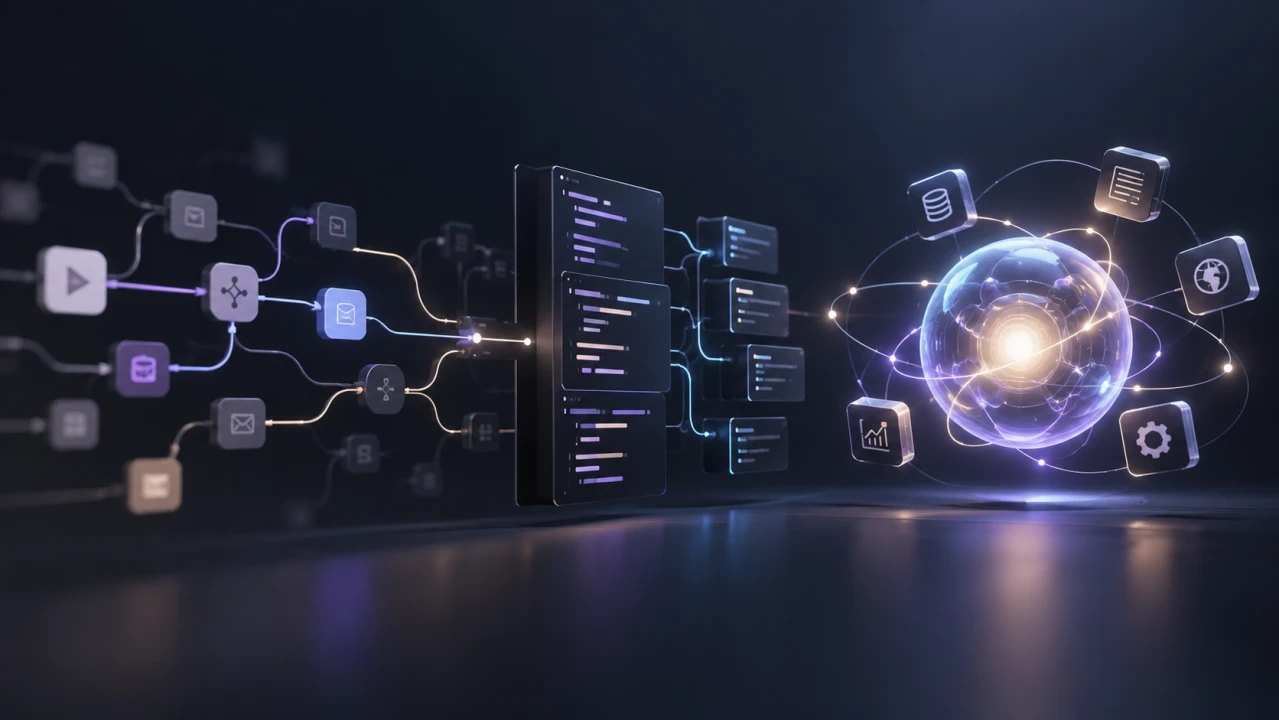
The common denominator: you no longer draw an agent as a network of boxes. You describe the task, give it access and a schedule — and it works out the steps on its own. In this article, we look from a software engineer's perspective at why Make and n8n are getting squeezed — pushed out by code on one side and by agents on the other.
Deterministic processes: a script, not a scenario
Where the same input must always produce the same output, we reach for code. E-shop order → invoice → ERP entry → warehouse notification. That's a classic software task, and as software engineers we solve it the way it should be solved.
Why a script and not a canvas:
- Versioning and code review — every change goes through git and a pull request, not through clicks in an editor.
- Tests — unit and integration tests catch bugs before production, not after.
- No per-step billing — the script runs on your own server, in CI or via cron. You don't pay credits for every operation, as you do in Make.
- No vendor lock-in — the logic isn't locked into a proprietary scenario format.
- Debugging and monitoring — the debugger, logs and alerting we already have for the rest of our software.
The “a scenario is faster than code” argument doesn't hold up in 2026. Coding agents like Claude Code write an integration script in a few minutes — and an engineer reviews, tests and deploys it. Speed used to be the main advantage of no-code platforms; today code has it too.
Meanwhile, Make and n8n have added AI: n8n has an AI Agent node with MCP support, and since February 2026 Make has been testing Make AI Agents. But an agent on a canvas is still a scenario with one “intelligent” step — needlessly fragile for determinism, needlessly limited for judgment.
Where they still make sense today: a quick prototype, or an internal automation run by a non-technical team without a developer.
What it looks like at Vibration: Make now actively runs on just one of our projects. We've switched n8n off entirely — what used to run there is now handled by an agent.
Grok Bot: a team of agents with their own computer
Grok Bot shows what an agent without a canvas looks like. xAI (now SpaceXAI) launched it in beta on August 11, 2026 and developed it together with Cursor.
Instead of a single chat, you get a roster of named bots — “research bot”, “email triage” — each with a permanent role. They all share one cloud computer with a browser, file system and terminal. They log into your apps, work on their own screen and come back to you only for approvals.
Three things stand out for automation fans:
- Routines — the agent runs on a schedule, for example a morning news digest every working day.
- Learning by observation — you show it the task instead of describing it step by step.
- Delegation — one bot creates and manages others, and the whole collaboration stays in a single thread.
The price of convenience: it runs only on Grok models, the agent inherits your full permissions, and according to independent analyses it still lacks an audit log. Excellent for personal productivity, still premature for production business processes.
Scheduled tasks in Claude: a prompt instead of a scenario
A scheduled task in Claude is the shortest path from idea to a running agent: you write the brief, pick a schedule, and you're done. No nodes, no field mapping — the agent picks its own tools through connected connectors and skills.
Anthropic currently offers three levels:
- The Claude app — scheduled tasks for knowledge work with access to connectors and skills; the model can be chosen per task. Well suited to reports, research and email triage.
- Claude Code Routines — run in Anthropic's cloud even with your laptop closed. They're triggered on a schedule, by an API webhook or by a GitHub event.
- Managed Agents — scheduled deployments in the Claude Console with a cron expression and a vault for credentials. Each run is a fresh, isolated session.
From our practice at Vibration: every working day at 6:00, a morning brief runs for us. The agent goes through the calendar, email and ClickUp and prepares a plan for the day focused on client projects and marketing. Another agent reads client emails via MCP and turns them into structured tasks in ClickUp — no retyping. As a classic script, this would be hundreds of lines of brittle email-parsing rules; the agent handles clients' varied wording on its own.
What to watch out for: the task runs without you, so the brief has to be complete — mid-run, the agent has no one to ask. And since every run starts from scratch, state (what has already been processed) must live outside the agent — in ClickUp, in a database, in a file.
Hermes Agent: an open-source agent that grows with you
Hermes Agent is the answer for those who want to own their agent rather than rent it. Nous Research released it in February 2026 under the MIT license, and it runs on your own server or laptop.
What sets it apart is its learning loop. When it solves a harder task, it records the procedure as a reusable Markdown skill following the open agentskills.io standard. Its memory survives restarts, and the agent can also search its previous sessions.
- One agent, many channels — Telegram, Discord, Slack, WhatsApp, Signal, email and the command line, always with the same memory.
- Isolation — five sandbox environments: local, Docker, SSH, Singularity and Modal.
- Model choice — the harness is yours; you swap the model underneath based on price or performance.
- Long autonomous runs — version 0.20 raised the tool-iteration cap from 90 to 500 and added voice and agent-to-agent connectivity.
The market takes it seriously: Nous Research raised $90 million for its enterprise version, Hermes for Businesses. The price of freedom is operations — security, updates and vetting third-party skills are all on you.
The comparison on one page
The difference isn't whether a tool “does AI”, but who drives the process: the engineer (code), you (canvas) or the model (agent).
| Tool | Who drives the process | Where it runs | Models | Control and audit | Best for |
|---|---|---|---|---|---|
| Custom script | Engineer, code in git | Your server, CI or cron | None, or any via API | Git, tests, code review, logs | Integrations, payments, ERP, high volumes |
| Make | You, visual scenario | Make cloud | Make AI, OpenAI, Anthropic, Gemini | Log of every operation | Prototypes, non-technical teams |
| n8n | You, scenario with an AI node | Cloud or self-hosted | Any, including local | Git versioning, approvals | Prototypes, internal tools |
| Claude scheduled tasks | The model, per the brief | Desktop or Anthropic's cloud | Claude | Output of every run, connector permissions | Reports, research, triage |
| Grok Bot | The model, a team of bots | Shared cloud computer | Grok only | Approvals, no audit log yet | Personal productivity |
| Hermes Agent | The model, learns skills | Your server | Any | Fully in your hands | Your own long-term agent |
On the horizon: Dots, Muse and the personal-agent wars
In September, the biggest labs confirmed the direction: the agent has its own computer and keeps working even after you close the app.
- OpenAI Dots — unveiled on September 29 at DevDay 2026, they run on GPT-6 Astra with their own cloud computer and browser. Through plugins they reach more than 4,000 apps and have built-in rules for when to act and when to ask for approval.
- Meta Muse — launched on September 8 in the US via its app and WhatsApp. It sends emails, books trips, fills in forms and shops, running in an isolated virtual machine.
One practical note for businesses in Slovakia and elsewhere in Europe: the Pro version of Dots isn't rolling out in the EEA yet, and Muse is US-only. Before you build a business process on either of them, check that it's available in your country and on your plan.
Verdict: code and agents, with the canvas on the sidelines
Make and n8n are caught in a pincer. On one side, they're being squeezed out by code, which now gets written as fast as a scenario gets built. On the other, by agents that work out the steps themselves.
The architecture we build for ourselves and for our clients has two layers. The bottom layer is code: e-shop integrations, ERP, payments, inventory — tested and versioned. The top layer is agents (Claude, Hermes) that decide, sort and write. MCP connects the two: a custom MCP server exposes to the agent exactly the operations we want to allow it — nothing more.
For every new automation, we ask three questions:
- Is the input always the same? Yes → script. No → agent.
- Does it need judgment, or just a rule? Rules get programmed; judgment gets delegated.
- What does a mistake cost? For payments and stock movements, the agent proposes and the code executes — with validation and human approval.
In other words: if you can write the process as a function, write it. If you can only describe it, hand it to an agent.
Code or agent? We'll help you decide
Vibration is a team of software engineers. We build custom e-commerce platforms, CRM systems and integrations — and AI agents on top of them, from an AI sales assistant to internal scheduled tasks. If you're working out what to write as code and what to hand over to an agent, get in touch.