RMF analysis is a tool whose strength lies in the fact that it brings opportunities to improve the marketing campaign through a better understanding of the purchasing behavior of customers. It is customer classification according to certain metrics.
The goal analysis is to find customers who have the highest probability of a positive response and at the same time expect the highest benefit in the form of profit. RFM streamlines processes and provides salespeople, marketing and company management with better and more detailed information about customers. Thanks to this, the relationship with the customer becomes more profitable and operational costs are reduced.
The article was revised and updated in May 2026. Check with specific service providers for technical information.
Customer segmentation using RFM analysis
From a marketing point of view, a good campaign is one that can target customers as precisely as possible. Knowing how to target your customers is the key to success in a marketing campaign. However, if we are to be able to target customers, it is first necessary to divide them into segments according to certain behavior models. RFM divides customers into three categories according to:
- R – doby od posledného nákupu (Recency)
- F – počtu nákupov (Frequency)
- M – celkového objemu minutých peňazí (Monetary)
Let's imagine that in each category we sort the visitors in ascending order. Thus, in the first category, customers will be sorted from those who spent the least with us to those who spent the most. In the second category, customers will be sorted in ascending order according to the number of orders, and in the third category, customers will be sorted from those who have not purchased anything in the past to those who have purchased a while ago.
After such an arrangement, we divide each category into parts that represent segments, and we number these parts from 1 upwards. 1 represents the least significant segment. Once we have that done, we start looking at our customers through segments and their meanings.
RFM cube
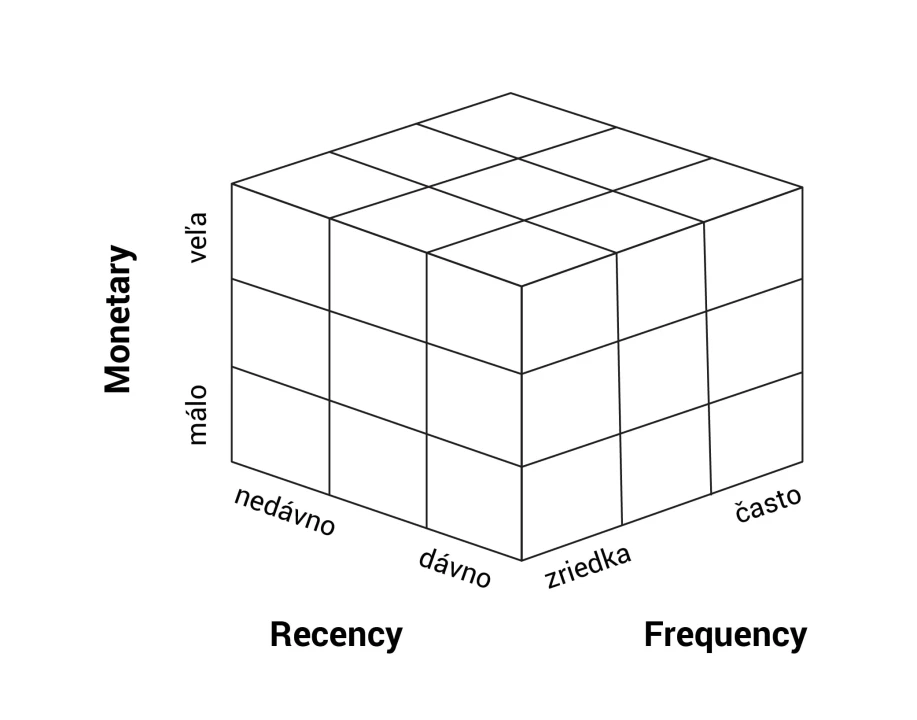
The next step is to transfer the categories to a cube, with each category representing one dimension of the cube. This makes it possible to further segment customers based on relationships between categories. For example, we can find customers who shop a lot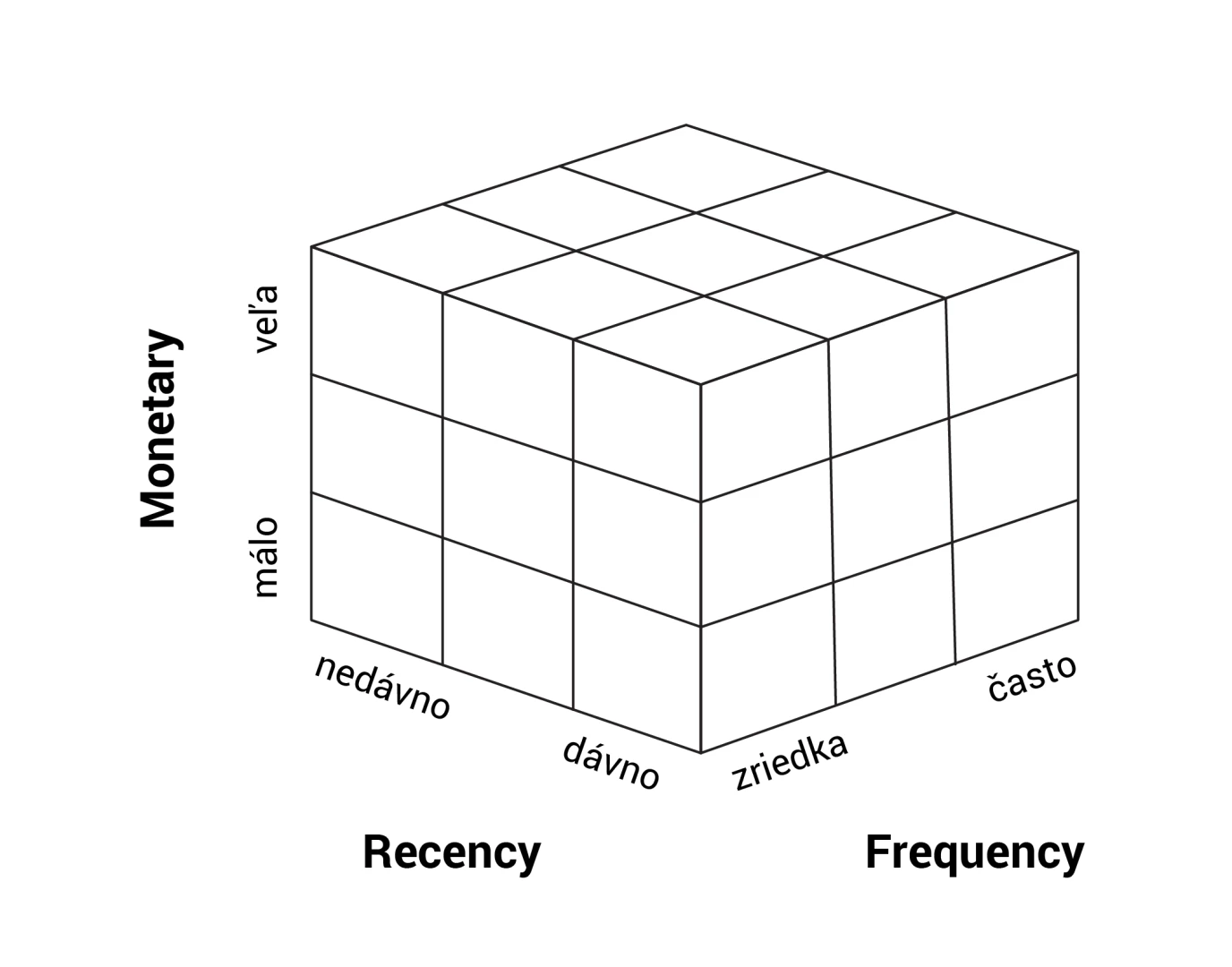 even often (Frequency), but they realize insignificant amounts of money (Monetary). Or customers who contribute significantly to the total turnover (Monetary), but it has been a long time since they last bought (Recency). Customers are ranked based on scores. For example, (3,3,3) represents a customer who has made a relatively recent purchase, purchases above-average frequency and above-average amount. Clearly, such a customer is worth more than a customer with a score of (1,1,1).
Targeted campaign using RFM
Thanks to the relationships between the categories, we can classify our customers into squares, on the basis of which the RFM segmentation is formed, which has its own classification concepts such as: loyal customers, big spenders, new cash cows and the like. For each classification, there are numerous recommendations and advice on how to behave in relation to the customer. For example, wish this a happy birthday, cough on this one,... With the help of segmentations, we can better target marketing activities. For example, it is possible to create specialized promotions or develop services for a certain group of customers. Applying the RFM score to your marketing campaigns is the easiest and most effective way to identify, target and reward your most loyal customers and retain them.
Sources of inputs to the analysis:
- Export from e-shop orders
- Export from the accounting system or ERP system
Use of RFM analysis
- personalized newsletters
- SMS campaigns - reminders, rewards, coupons
- direct mailing – sending offers only to the best customers, or increasing the retention of potentially creditworthy customers
- customer support access - for example, VIP access for the best customers
- contacting by phone
- remarketing - customizing audiences
Tools for creating RFM analysis
Či už využívate eshop systém na mieru, krabicový systém alebo open source, export dát si viete spraviť v rôznych formátoch. Ideálne je napojiť priamo živý zdroj dát, ktorý sa automaticky aktualizuje. Tieto dáta potom viete zobrazovať a segmentovať napríklad v týchto nástrojoch:
- Excel
- Google Sheets
- GoodData
- Power BI
Of these tools, it is important that you know how to feed online marketing tools and ideally send automatic mailing.
If you need to implement RFM analysis in your eshop, set up data driven decisions in yours digital marketing, then we at vibration will be happy to advise you.