
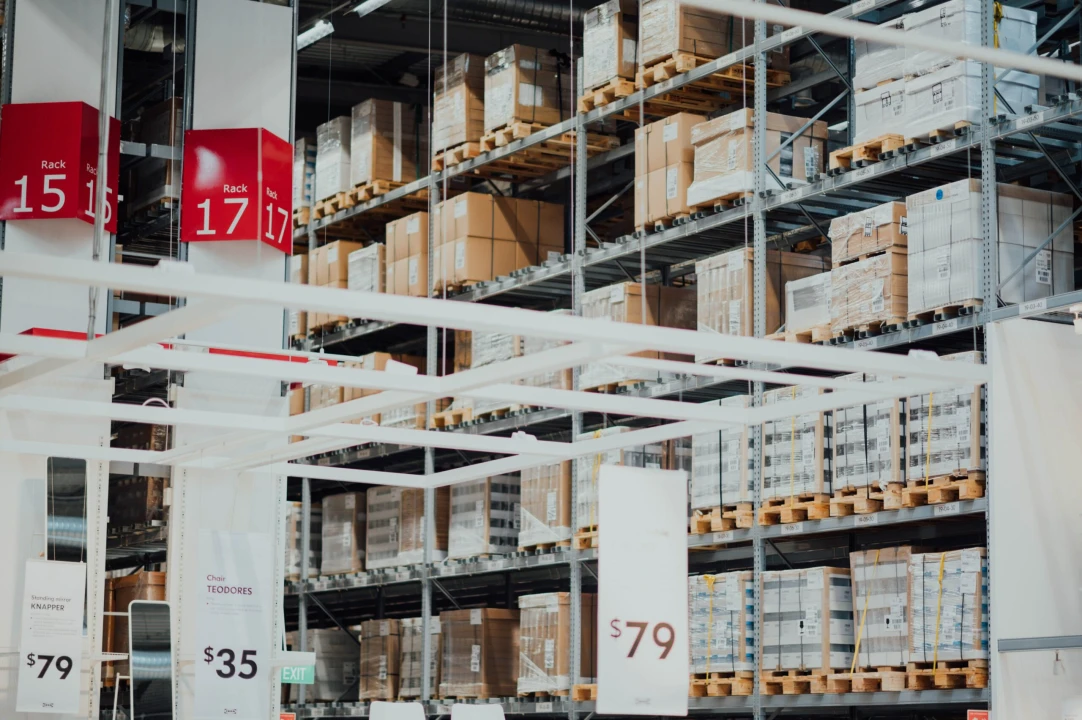
The e-shop warehouse plays a key role in the ordering process. A lean and efficient warehouse keeps sales flowing. Conversely, too much inventory and disorganization unnecessarily slow down the sales process. So how can you achieve an organized warehouse?
Effective warehouse design certainly includes effective layout and optimization of space. Furthermore, it is the marking of products and shelves, software for the management of systems and technology, or designated areas for picking up goods.
The article was revised and updated in May 2026. Check with specific service providers for technical information.
Clean and well-organized warehouses they are ready to receive goods, prepare orders, load containers, and most importantly, keep customers satisfied.
However, organizing a warehouse is always easier said than done. Every decision should support the goals organization while increasing productivity, optimizing space, reducing costs and delivering superior customer service.
If you are struggling with your warehouse, or figuring out how to access it, read the following tips for organizing the e-shop warehouse.
General tips for organizing the warehouse
Building modifications
Existing warehouses that meet the requirements for an e-shop warehouse are rarely perfect. Additionally, age and condition may make some available devices unacceptable. That is why construction modifications are necessary, during which you have to think especially about the height of the ceiling and lights, the condition of individual devices or the number of docking doors. Everything depends on the current and future size of the e-shop, depending on growth.
Keep the warehouse clean
Reserve 1-2 hours a week, or monthly to clean the warehouse can lead to improvements in efficiency. You never know what missing orders you might find. A clean warehouse means warehouse workers can move faster and complete their tasks more easily.
Selection of stock material
Handling and storage equipment enables companies to process, package, store and ship materials and products. Between the most commonly used manipulation tools include conveyor belts that quickly and safely move materials from one place to another. These engineered systems facilitate the rapid transportation of heavy and valuable goods.
Companies also benefit from storage systems such as pallet racks that store products on horizontal platforms. Next, there are warehouse dividers, a useful tool that protects products until they are ready to be shipped to their final destination.
Metal and wire shelving is the foundation of any warehouse or manufacturing facility: these robust surfaces allow businesses to store and display goods and are useful for product inventory management.
Choosing a storage system
Software solutions to control and manage warehouse operations fall into of two broad categories: warehouse management systems (WMS) and warehouse control systems (WCS).
WMS systems enable precise management of all activities within the four walls of the distribution center. These activities include receiving, putting away, storage management, picking, packing, shipping, labor management, work planning, warehouse setup and analysis.
WCS systems provide computerized control of automated equipment such as many of the items listed above in the stock selection section. Although not all software developers provide both solutions, most WMS providers also offer a WCS solution.
Reduce clutter
A disorganized or messy warehouse indicates to visitors, suppliers and employees that there is a lack of efficiency. It can also mean that potential sales are being lost, warehouse workers are overworked, or that company morale is low.
Adopt a low inventory practice
Keeping inventory levels low means that you only have as many goods in stock as you actually need and nothing more. This means workers have fewer products to sort through when organizing new inventory or completing orders.
Try reducing your stock in reserve, or see if suppliers can supply less stock on a more frequent basis. Once shipments are delivered correctly, you can increase your efficiency with low inventory.
Pay attention to safety
When it comes to safety is the highest priority. After safety, you can think about efficiency. The last thing you want to do is put your employees in harm's way just to increase sales. When it comes to storage, a safe warehouse is an efficient warehouse.
Use the shelves and the space
When looking for ways to improve warehouse efficiency, a good way is to understand how racks and space are being used. The placement of racks and containers, along with traffic patterns and overall building design, all affect the ability to use the available space.
Adjust the organization based on the industry
Each organizational system should be adjusted for the specific branch of the e-shop. Sometimes multiple items will be shipped at the same time to the same location.
Keeping all goods in the same area helps all employees find their shipment and load it onto the truck. On the other hand, if individual packages must be sent to different destinations, different organizational systems that may work need to be tried.
Reduce the number of containers shipped
Minimizing the number of containers used in a warehouse may seem like a small step in streamlining processes, but it is important for increasing worker productivity. You might think that having several sizes and shapes of containers can eliminate waste, but it can also slow down workers who have to choose the best container for a given item.
Keep error rate statistics
Even in the most efficient and organized warehouse, mistakes will occasionally occur. To maintain statistics of such stocks and how often they occur can improve key insights into areas that have room for improvement.
Use stackable shelves
It is an easy way to storage of small goods. Storekeepers can use them to organize and access small products that are in high demand. Every warehouse can use them, as smaller stackable shelves can be placed on tables and shelves. As a result, you can also use them to store printed labels or documents such as invoices.
Train warehouse staff regularly
There are two solutions to keeping your warehouse organized. They are the first regular training for employees of the warehouse about the importance of keeping the warehouse organized.
The second is to use tools to maintaining current stock levels. Keeping the warehouse organized becomes part of the company's culture when it is the subject of regular training.
Implement a cycle counting system
Instead of one big inventory once a year you master the cycle, in which stocks are counted one or more times in a given cycle. It can be monthly, quarterly, or as many times as you want. This helps keep inventory levels more accurate, as well as identify stock shortages and order errors.
Eliminate activities that do not add value
The path to a lean organization leads to the constant elimination of unnecessary processes. Review all processes at least once a year to make sure you are not doing redundant activities. Also evaluate the product mix to confirm new popular goods that are stored closer to the collectors.
Tips for marking goods and the technology usedu
Labeling of shelves/warehouse segmentation
Label the shelves from bottom to top. This practice is especially important for warehouses that work with a high-density racking solution that contains multiple levels. But even if it's a small warehouse, you still should label your shelves from bottom to top.
Start with "01", continue with "02", etc. It's wise to use a double digit model even if you don't currently have enough levels to create one. This is because the system allows you to name more levels without making any numerical changes if you have actually decided to expand your inventory.
Use the serpentine or standard method when marking.
Serpentine method
Warehouses using strategic picking techniques due to large SKU volumes or fast-moving inventory mostly benefit from the serpentine model. In it, collectors are moved from place to place, up and down the aisles.
Using this marking model, pickers can quickly traverse the warehouse floor without doubling back to previous locations. In this case, the aisles are usually labeled alphabetically - units AA, AB for aisle 1 and units, BA, BB for aisle 2.
Traditional method
Picking techniques are not necessarily considered in the standard labeling model, meaning that pickers must move from location to location to pick the correct product orders, often doubling the time to return to previous locations. In this case, the aisles are usually marked alphabetically and in numerical order from the first rack system.
Oposition marking in stock
Start with it in the first area/room/zone you want to start marking and stand in front of where you want to start the sections.
Then create a label. Remember that you want to include the name of the entire area on the label. If using strips of paper, pen and tape, write the name of the place on a strip of paper, make arrows, and then cover it with clear tape.
Your labels should start with the zone abbreviation (if you use zones), the section letter (if you use sections) and then go down from 1-10 or A-Z from the highest point to the floor. If you have two shelves next to each other on a shelf, consider ending one with a letter L and the second by a sign R (for left and right).
Use information labels on all products
This will ensure that you can easily store and store inventory as you browse. If they are e.g. goods marked with the SKU (stock-keeping unit) number together with the product type and description, you can then search for them by labels.
Tlach labels v stores
Many warehouses print barcode labels using 4-inch desktop thermal label printers. Labels were often designed to print a bar code in the shape of a fence.
In the case of a blown pixel in the print head, this method can cause barcodes to fail. Scanners will no longer read them in the delivery hall. This could cause wasted returns and shipping, misidentifications, and a possible black mark as a supplier.
When scanning this barcode, the scanner will incorrectly delete these missing commas as part of your barcode. This will cost you more time and resources to retrieve cartons marked with damaged barcodes.
By ensuring that barcodes are printed in a ladder format after they exit the printer, you will protect the integrity of the barcode.
To do this, rotate the label, or try rotating the label format 90 degrees. This way, if the pixels in the printhead fail, the printer will still produce a readable barcode.
When scanning this barcode, the scanner will still read the barcode correctly. It's also faster and easier for the user to spot errors, saving valuable time.
Label products with QR codes and use a QR code reader
QR a čiarové kódy sú nevyhnutné pre moderné riadenie zásob. Ak ich nepoužívate, váš sklad je na úrovni stredoveku. Pri spárovaní so správnym softvérom založeným na cloude, QR kódy poskytnú podrobný prehľad stavu zásob vo vašich činnostiach v reálnom čase, čo vás ušetrí od príliš veľa zásob na sklade (kedy musíte predávať za nižšiu cenu), alebo príliš nízkeho stavu zásob (vďaka čomu budete stíhať dopytu). O QR kódoch sme napísali viac v článku Kde a ako správne používať QR kódy.
Connect the e-shop with the warehouse
Your competition uses every technological advantage to optimize operations to gain competitive advantage. Take the time to identify repetitive tasks that can benefit from automation.
Whether it's a link software with the e-shop website and managing the warehouse (warehouse management system, hereinafter WMS), which organizes orders, to the solution of conveyor belts for faster completion of orders, all these technologies have a place in your warehouse.
Use EAN codes
European Article Number (hereafter EAN code) is a type of barcode. It is used to identify products and defines the goods you are selling. You can find them mainly on branded products that have their own manufacturer and model. He's going mainly about fashion products like clothes, sunglasses, watches, etc. Using these EAN codes, which are usually publicly available, will make the overall administration easier.
Use an appropriate goods control system
Once your inventory is in the right place in your warehouse, it's important to keep detailed records with a good inventory control system. It is the process of managing the location, inventory on hand and movement history in the warehouse.
Determine the order of the orders using the software
You can save a lot of time by using order sequencing software. You can choose to specify orders in terms of route selection, group orders by zone, group some orders together, or set aside orders that include non-portable items.
Use WMS software that allows you to organize the work process so that it makes sense to organize and optimize the way orders are determined in order.
Automation of processes in the warehouse
Warehouse automation enables warehouse operation achieve greater results with significantly less effort using one or more technologies. The best warehouse automation solutions are scalable, ergonomic, and provide a return on investment in months, not years.
Warehouse automation has two parts: process automation and physical automation.
Automation processes, sometimes referred to as system automation, digitizes manual processes such as inventory data collection and integrates that data into your software environment, such as a database or Enterprise Resource Planning (ERP) system.
This type of automation runs on a system of barcodes and wireless barcode scanners that enter and track data, which is then reported via software to a centralized repository where the information is stored for future retrieval.
Physical automation, which includes various forms of mechanized automation, refers to the use of robots and robotic systems in the warehouse. Physical automation is more expensive to implement and only provides a reasonable return on investment for larger high-volume warehouse and distribution center operations.
Examples of physical automation include goods-to-person (GTP), automated guided vehicles (AGVs), and autonomous mobile robots (AMRs).
Warehouse layout tips
Rethink your design
No matter how organized you are, if your sales increase every year, you will need a new warehouse layout design, or even a completely new warehouse. As sales increase each year, this means that space requirements will naturally have to be reassessed. This space evaluation is recommended to be done every 3 to 5 years, depending on how well your company is growing sales.
Create a profile for your orders
Your most popular SKUs probably change with each season. Therefore, supplement the warehouse appropriately to handle your business model. Evaluate your setup at least once a year. This will ensure that your A-grade products are in the correct area, reducing the necessary travel for your warehouse workers.
Consider vertical storage
Floor space is limited. Vertical storage can thus offer more stored products. It requires the right type of shelving for products with an emphasis on safety and easy access. Poor use of available warehouse space is a known problem and can be easily solved with modified racking systems.
Classify the goods
How exactly goods should be classified depends on several factors. The key factors are the size and weight of stored products, along with the frequency with which they are picked up. It has proven to be effective to evaluate all stored products and not just focus on the optimization of fast-selling products.
Pareto's 80/20 rule, where 20% of products account for 80% of sales, does not apply here, because it means that the company is not considering 80% of its products.
Ensure sufficient space in the aisles
Yes, you want to use the maximum warehouse space. But remember that when you move goods, you need room to maneuver. If you've narrowed the aisles by placing too many shelves, moving products can take minutes to minutes instead of seconds.
Keeping the aisles clean and open will save you time and money. Your workers may stumble or drop goods while moving items in crowded aisles. You can designate one worker to clean the aisles to make sure it is taken care of.
Use slotting
Slotting is the process of keeping similar types of inventory together. It provides great benefits in the form of increased permeability and an increased level of accuracy. Categories include turnover rate, physical size, complementary products, seasonality and other common characteristics. This will increase accuracy by reducing search time.
Reduce move time
Reducing shipping time improves order picking productivity. Because of this, the picking strategy in batches and clusters is used in warehouses. That is why some companies invest in conveyor systems.
Moving time accounts for 50% and more hours of pickup. By combining orders into one trip, moving time is reduced. The smaller the order, the better the opportunity to combine multiple orders into one trip.
Provide easy access to collection bins
When using collection bins, make sure they are easy to access and move around in the warehouse. A lot of time and energy can be spent on moving the collection bins to the necessary goods. Remember that anything that looks difficult or strange poses a risk of injury, which leads to additional costs.
Make sure the collectors can see the collection bins easily. Even if you have an automated process and everything is being scanned, a visual inspection can spot multiple potential errors.
Tips for receiving supplies
Designate a dedicated area for receiving supplies
A lot of storage mistakes happen in receiving when your workers don't have enough space to work. Eliminating acceptance errors relieves you of all the problems in the sales cycle, such as wasted time, money and credibility.
Create processes for receiving and processing inventory
Learn how the inventory process works in your e-shop. For example stock may arrive in the receiving area of the warehouse, so describe how stock moves from receiving, who is responsible for logging stock into the system, and how stock is placed on shelves.
Ensure that part of the orders arrive at once
Multiple order components should arrive at the warehouse in close sequence so that the order goes straight to the trailer instead of being stored somewhere and waiting for the next move.
Packaging of orders
There are several ways to package orders.
Single packaging
This is probably the most straightforward packaging method that most companies start out with. Orders are picked one by one as they arrive.
The process can be as simple as sending a warehouse worker into the warehouse with an order in hand and having them pick items off the shelves until each order is filled. This process is easy to implement, but is rarely very effective in anything like the smallest warehouse.
Group packaging
Warehouses that have a bit more traffic will usually need to find a more efficient way to fill orders, and for many, batch picking is the next logical step.
Batch picking is similar to piece picking, but rather than picking orders all at once, the order picker can fulfill several orders at once. This will make operations through the warehouse more efficient and enable more orders to be fulfilled more quickly. However, as the volume of orders increases, there are still limitations.
Zone packing
Zone packing recognizes that piece picking and batch picking are not the fastest ways to pick an order and that many hands make the job easier. When selecting zones, warehouses are divided into zones or areas. Order pickers are assigned to pick items only from assigned zones.
If items from multiple zones are needed to fill an order, workers for those items are moved from one zone to another until the orders are filled. These boxes are often moved using a conveyor belt, but they can also be moved by hand.
Wave packing
It is essentially a combination of zone and group packaging. Orders are picked in groups, with workers assigned to the zone in which they will pick group orders.
For even greater efficiency of the company they can switch to automatic picking, either using a sorting systems method where the orders are actually delivered to the picker using a conveyor and automated storage units.
Next is here pick to box method, which is similar to the sorting systems method, but involves multiple picking of carts at multiple stations, with boxes moving on a conveyor between stations. However, automated collection can be expensive.
Checking the content of the order
Content review is usually performed on a percentage of randomly selected units on the "platform". The most common practice is for the supply company or vendor to transport orders to a shipping warehouse where an external inspector will perform a quality control inspection.
If the products do not pass inspection, they will have to be shipped back to the warehouse instead of being shipped to the customer. This method is ideal for large purchased volumes. However, many companies often find it impractical due to the cost of transporting units from the factory to the platform (and vice versa, if rework is required).
Tlach labels for couriers
Courier and logistics companies require several pre-printed self-adhesive labels to ensure that the correct package is delivered to the correct client. Pre-printed templates can be printed so that the barcode label printer can print important information within defined areas.
Unloading goods
Every bit of warehouse space dedicated to excess stock is a lost opportunity. They take up space for the best-selling inventory items. Getting rid of excess inventory can free up that space and increase revenue potential.
There are several ways to get rid of excess inventory. It may affect profit margins, but at least you can get back at least the purchase price you paid.
Combination of sales with other goods
Combine excess inventory with multiple current items and sell them in combination at a discount. This way, you can quickly move a large number of items and get that excess stock out of storage.
For example in Japan there is a popular concept where retailers create so-called "happy bags". They combine last season's merchandise, sometimes with multiple current items, into a mystery bag that customers can purchase.
Giftchecks for purchases
Everyone likes free stuff, so a gift with purchase encourages customers to spend a little more to get it. Not all customers will want to pay full price for an item they don't like, but the perception of good value for money through giveaways and discounts is a big motivator for customers to buy.
Donation surplus goods
For retailers, it is likely that some excess stock has value for charities or non-profit organisations. By donating unwanted items, you can create good PR and use the value of the donation as an expense item in the accounting.
Return of stock supplier
Do you have an agreement with the supplier on the possible return of stock? Even if you have problems moving stock, if the stock is still current, your supplier will be able to move it elsewhere. If possible, be prepared for the fact that it will not just happen and you may have a small loss.
How to do a warehouse inventory
The goal of warehouse inventory is to ensure complete parity and accuracy between the actual amount of inventory located in your warehouse for each item type (and its variants) and the recorded amount of inventory in your inventory tables or inventory management software.
This helps prevent overselling when the actual inventory level is lower than recorded. In addition, it will help correctly value the inventory for the tax return. It is important for any retailer or warehouse operator to regularly ensure that the recorded inventory matches the actual inventory.
There are two ways to perform a physical inventory count:
1. Manual inventory count
Traditionally, this means suspending operations on site to carry out a planned count using paper lists for manual counting.
2. Digital inventory counting
It includes the use of a smartphone with mobile application and/or barcode scanner for electronic control and recording of numbers into a centralized inventory system.
How to maintain more warehouses?
Once companies start to grow, having one warehouse in one place will no longer be enough. If your brand is growing, shipping your items from one warehouse across the country can cause shipping delays for your customers.
There are several tips on how to maintain more warehouses.
Keep data in sync across different locations with the right tools
As with other processes, using the right technology can make inventory management much easier. If you have multiple locations that require inventory management, you need a tool that is robust enough to meet your needs. You can automate some of these time-consuming, manual processes and gain more transparency in your operations across all your inventory storage locations.
Adjust the layout of your warehouse
Explore the layout of all your warehouses. Are they optimized for efficiency? Is the layout logical and easy for employees to navigate? If all your warehouses are well organized, the layout can positively affect the speed of delivery for customers.
If products are not properly classified, or if your warehouse is a confusing maze, it takes longer for employees to find and ship them to customers. And as we know, faster and more accurate shipping equals higher customer satisfaction.
Consider geography
Choosing the right location for your warehouse is crucial for faster order fulfillment. After looking at the sales data, you can find regions or cities with a high concentration of your customers and take them into account in your decision about the next location of the warehouse.
It will not work without an efficient warehouse
The success of the e-shop requires high-quality IT and mastered logistics. Vo vibration will take care of IT + digital marketing. Creating an efficient warehouse requires a great deal of work and time. However, if you put in the effort, you will be rewarded with a more efficient ordering process and satisfied customers.
Are you looking for a complete e-commerce solution + warehouse solution? Try Sellio
Our Sellio system represents a ready-made e-commerce solution, including a warehouse solution. We know him fully customized according to the needs of your company. Within Sellio, it is possible to create an order check via readers.
V Sellio is possible use more warehouses and print classic documents such as receipts or expenses. It has a production module for products that can be connected to any other system. Our Sellio system is connected to systems such as MRP, Pohoda, Omega, Altos Varios, Money, Proluc and others.
Contact us and together we will look at your e-commerce project.