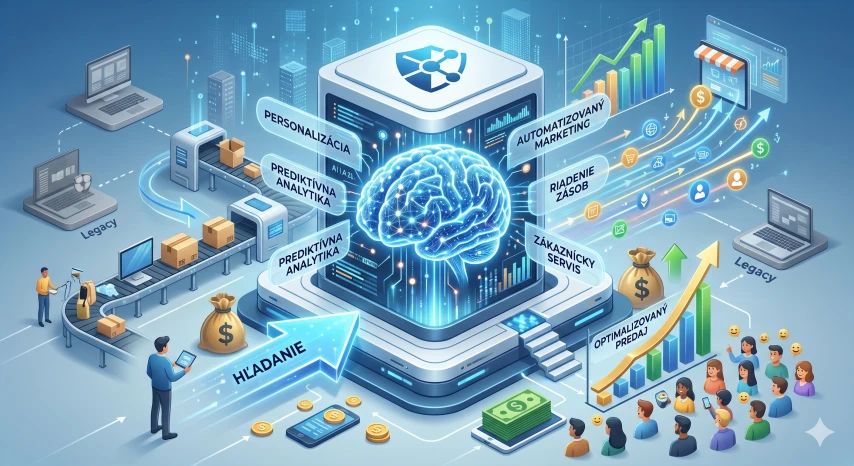

B2B, v skratke Business-to-Business, predstavuje firmy, ktoré predávajú svoje produkty a služby ďalším firmám. Online predaj zmenil spôsob predaja vo všetkých sektoroch, čo platí aj pre B2B.
Business to business is a sale between two companies. It may include a supplier and a manufacturer, or a wholesaler and a retailer. B2B transactions are typical in the supply chain, where companies purchase parts and products as materials that are used in the manufacturing process.
The article was revised and updated in May 2026. Check with specific service providers for technical information.
If it is a target market, transactions in B2B are on average more valuable than in traditional B2C. This is not surprising as companies have more capital to spend compared to the average consumer.
B2B sales often take the form of selling inventory or parts between companies. For example a tire manufacturer sells its products to a car manufacturer. Another example would be a wholesaler that sells its products to retailers. They sell them on to consumers. Supermarkets are a classic example. They buy food from wholesalers and then sell it with a margin to ordinary people.
B2B e-commerce
The Internet provides a vast environment in which companies can find suitable suppliers and customers for their products and services. E-shops allow potential business partners to view products and services and start a business relationship.
Specifics of B2B e-commerce
Simple display of products + bulk purchase
In a classic e-shop, the customer looks at individual products with high-quality photos, reads the description, advantages, disadvantages and compares them with other products before purchasing.
On the other hand, B2B customers need a clear list of products with essential information (name, properties, number of items in stock, delivery, price, code). For B2B customers, it is therefore ideal to display goods in categories along with the possibility to choose the number of products to buy.
Filtering goods through categories
Some companies sell hundreds if not thousands of products. In this case, it is worthwhile to use a filter that will make it easier to search for products. Currently, the active filter that does not display empty results is most often used.
Export of products via API or XML/CSV feeds
In every e-shop you have a list of products, their prices and current availability in stock. This is important information for your customers who need to know how quickly and how many products they can order from you. Therefore, it is important to have this list in the API or XML/CSV feed.
It is best to implement an API. Thanks to it, the customer can download data as needed and check the availability of selected goods. However, one must also think about the load of the e-shop, which can slow down due to excessive demand. However, this can be solved by imposing restrictions on the time when the API is available, limiting the number of requests if necessary.
A simpler alternative to creating an automatic list of e-shop products is to use an Excel table in CSV format, or XML, which is more complex. The list must include data about the products, prices and current quantity in stock.
Expedited purchase
As mentioned in the previous section, customers usually buy the same thing. They therefore know what they want and have a ready list of products with codes in the required quantities.
Therefore, you can also integrate a quick purchase into the basket by code or product name.
The customer enters codes with quantities in the search and does not have to waste time searching for products. A more advanced way is to import the order in CSV format. The customer uploads an Excel file to the e-shop with two columns for the product code and the required quantity.
Wishlist and favorite products, repeat purchase
Wishlist and favorite products are convenient for subscribers and for you. In this way, you will find out when and for which products there is the greatest demand and, subsequently, you will be able to replenish the warehouses.
Customers often buy the same products in the same, in some cases, the same quantity. That's why it will help them if you add a repeat order function to your e-shop. This is most often in the form of a button in the history of orders.
After selecting this option, the same products as the last order will be added to the customer's cart. If all products are available, it will redirect him straight to payment. If not, it will receive notifications about products that you do not have available in stock. However, you can recommend alternatives.
Price setting: price levels, discounts and individual prices
In the B2C e-shop, every product has the same price for all customers. Discounts are used, or dynamic prices based on product traffic can also be used.
However, it is a bit more complicated for B2B. Every customer wants to get the best possible price. For a B2B e-shop, a difficult situation can arise when each customer wants his own price. But there is a simple approach to this, when one wholesale price is used, which is displayed to all customers. Subsequently, price levels can be created with an exact price or a percentage discount.
Purchase of large quantities and associated price offers
In B2C, the sale of individual products is typical. In B2B, however, it is usually in pieces, pallets, cartons, or packages. It is not recommended to buy products individually, you will save costs and make delivery more efficient. Such sales require setting prices according to individual quantities, whether in pieces, kilograms, or liters. It is recommended to have a clear pricing of quantity discounts when purchasing 10, 100 or 1000 pieces.
Detailed account information for customers
The fewer questions customers have about buying from you, the better. It is proof that you have a clear e-shop and that you effectively provide information. There are several pieces of information that every customer should have available about their own account. It is mainly about:
1. list of orders: closed and open,
2. list of documents for individual orders: invoices, advance invoices, tax documents,
3. change of invoicing and delivery data,
4. complaint and order return,
4. lists of products and favorites (frequently purchased products),
5. list of personal data and granted consents with personal data.
B2B vs. B2C, C2C and B2G
Let's look at how the B2B sector differs from others.
B2B vs. B2C
You might be surprised, but B2B e-commerce has a lot in common with B2C e-commerce, where most of the processes are similar, if not the same.
Where there are differences is with the customers. Traditionally, B2B buyers are high-level executives. B2C purchases are primarily based on personal preference, where the average consumer only cares about satisfying his or his loved ones' needs. This means that in general, B2C consumers are not as informed about products as B2B buyers, which makes the sale easier.
Additionally, trying to convince a B2B buyer to switch suppliers can be challenging. Mostly, the relationships between the buyer and the seller in B2B are set up in such a way that a change of supplier can cause major problems in everyday processes. This means that purchasing decisions require more time and, in some cases, more money to commit than in B2C sales.
B2B sellers therefore need a little patience and should focus on offering a premium user experience. As part of the marketing strategy, company owners must be able to clearly state the benefits of their products and services.
B2B vs. C2C
In a C2C (consumer to consumer) business relationship, sales take place between two consumers. Whether it is goods or services, this category of e-commerce connects natural persons who sell to each other.
A simple example of a C2C transaction is a sale through a bazaar. The seller publishes an ad where he offers the goods and states the required price. Subsequently, he receives offers from interested parties. He can sell the product at the required price, or he can agree on a price with the buyer.
The goal of the C2C platform is to enable these business relationships to take place by helping buyers and sellers find each other. Customers can benefit from competition for products and easily find products that would otherwise be difficult to find.
Thanks to the Internet, such transactions could be fully expanded. Among the most famous platforms is eBay. Anyone can log in and start buying or selling.
B2B vs. B2G
B2G, business to government, is a relationship where companies sell their goods and services to state authorities. A big difference in comparison with B2B and B2C is that in B2G models companies generally respond to requirements published by a government body through a process given by law, in other words a tender. Subsequently, companies submit their offer and the tender that best meets the given conditions wins (at least that's how it works in theory).
The buying cycle in B2G can be long, even several years, compared to months in B2B, or one day to several weeks in B2C. B2G sellers must study and comply with the terms, regulations and applicable laws regarding government procurement. There is also a much stricter control, as there are public funds in circulation, and in some cases also funds from European funds.
Problems that vibration solves in B2B
As an agency, we have several solutions that we offer to B2B companies. It is the following.
E-shop for the B2B segment
We created our own e-shop system sellio for wholesalers. It has common functions of a classic e-shop, with additions designed for B2B wholesalers. We offer it together with connections to other systems, such as warehouse systems, accounting systems and CRM systems.
Main functions
Price setting: Price configurators
Do you have calculated prices of configured products in Excel? Then it is not a problem for us to do it online. In the purchase process, the customer can choose the selected configuration with a preview of the final product. This way, your subscribers get a better idea of what they can buy and you save time with additional phone calls.
More efficient orders
Simplify sales by enabling customers with sellio to:
- search for products by name, code, description or parameters,
- enter orders using import from Excel and thus save time,
- place a bulk order on all devices (computer, smartphone, tablet),
- bulk orders are simplified and can be repeated,
- enable online payments.
Creation of a wholesale zone
After logging in, customers can see prices according to their classification in price levels, or they can see individual prices. They have available information about the state of the warehouse, or restocking of individual goods.
Automated invoicing and billing
After receiving the order, sellio creates the given documents based on your company's settings.
Streamlining business processes
Sellio helps you improve by doing the following:
- removes redundant phone calls and e-mails, giving you an overview of your orders,
- your sellers can add new customers, assign them an assortment, along with individual prices and discounts,
- elimination of manual orders or duplicate data entry into different systems.
Creating a loyalty program
With the help of sellio, we will create a loyalty program that will allocate individual benefits, discounts or gifts based on the turnover of individual customers and the specified conditions.
Creation of a provisional system
It ensures that your salespeople earn commissions based on turnover or other set goals. Can also be set for individual subscribers.
More transparent processes in production and warehouses
Simplify your own production by setting up management, production control and warehouse automation. When shipping orders, we can e.g. check the order using the EAN code reader.
Analysis and application of processes
Every company must have a management system. We will help you with its setup, along with the processes. We will look at:
- acquiring new customers,
- production,
- sale,
- financial control,
- resource management,
- Accounting,
- customer care.
We transform your ideas that you have in your head or on paper into digital form into given documents. We will help you with the design of the structure of the entire ecosystem, the selection of the right services, systems and their interconnection.
Interconnection of systems and services
The present and the future of online business is in connecting services and applications via API (application programming interface). The solution is the joining of ready-made services into larger parts, or the completion of tailor-made microservices and their interconnection.
Integrating new services into existing solutions
Do you have an information system or web application? We will connect them with other service systems. It doesn't matter if it doesn't have an API, we can create one for you.
Creating digital ecosystems
Try to imagine the following:
- have business at your fingertips 24/7, accessible from anywhere on all devices,
- automating manual processes that take a lot of time,
- reducing costs, increasing productivity, saving time and making management easier.
These are the benefits of a digital ecosystem. It is a network of interconnected services and systems. Individual parts have their own role in the system, which helps the overall goal.
Systems used for B2B sales
E-shop systems adapted for B2B sales
It is a classic e-shop that includes a superstructure with services intended for the B2B segment. An example is our sellio system described above.
Order systems
Ordering systems are part of many e-shops. So why couldn't they work in the B2B segment? The introduction of the system will enable simple ordering via any device. After the order, you and the customer will receive an immediate confirmation.
The order can be tracked from warehouse pickup to delivery using GPS. When delivered by a courier company, the customer will receive an SMS message or e-mail. You will also receive a confirmation after delivery.
Order by phone or e-mail
A classic ordering system that has been used since the expansion of telephone communication. It will probably stay here forever. Communication over the phone is immediate, fast if the communication is correct, and both parties have a clear confirmation of the concluded deal. The disadvantage is associated with manual work, which includes administrative processes associated with the order.
How to do marketing for B2B
A marketing strategy for the B2B segment is different from a typical B2C strategy. You'll notice a few similarities, but for most you'll need a new plan if you want to target other companies. Let's go through B2B marketing step by step.
First, define your subscribers
When it comes to B2B marketing, this step differs from the traditional process of identifying a target market. You need to be more specific here. You have a unique product or service and you need to determine which companies will benefit from your sale.
Who do you sell to? Is he the owner of the company? Is he a production manager? Is it the person who answers the phone after you call? Determining who has purchasing power is not the same as identifying a target market. Therefore, it is helpful to create a customer persona, which must be very specific.
Focus on long-term relationships
A B2C customer can order a product online from the website in 5 minutes. But the B2B customer will require more assistance with the selection. Let's say you sell office chairs. If a consumer buys one chair for a home office, you don't earn a bundle.
However, if the chair corporation orders them from you to all departments, this is a relationship you cannot lose. That's why you need to go the extra mile and do what you can (within your options) to build long-term relationships with your customers.
Personalization matters
In some cases, products and services need to be personalized based on needs. However, it has obvious limitations. If you're building boats and the client wants motorcycles, there's not much you can do here. Well, if you make small cups, but the client wants bigger cups to use their logo, you could accommodate them.
Sell your story
Ovládať umenie storytellingu je dôležité nielen pre B2C segment. Mať skvelý príbeh a prezentovať ho na webstránke, alebo ako súčasť hodnoty môže pomôcť generovať leady. Povedzte klientom, ako ste sa dostali do odvetvia. Koľko rokov máte za sebou. Aké úspechy ste dosiahli. Koľko spokojných zákazníkov ste obslúžili. Na toto sme napísali článok na tému kompletný návod pre B2B content marketing.
What is a B2B zone?
As for B2B sales
The sales cycle in the B2B segment begins long before the first salesperson initiates contact. Actually it is up to 57% of the decision-making process carried out even before communication with a potential customer begins.
In most cases, the customer is clear about the products and services he is interested in. They could see the offer of products and services in advertising, either online or offline, or visited the website. As many as 9 out of 10 online shoppers say that content influences purchasing decisions. It's the salesperson's job to convince customers to buy.
Sales techniques
Marketers use different techniques for B2B sales. 84% of B2B sales starts with a reference. The client thus already knows the product. This makes it easier for sellers. However, they still have to convince clients about the product. Salespeople say that having a good attitude, using a targeted list, personalizing communications and not taking no for an answer helps improve B2B sales.
B2B sales were associated with cold calls. But since 90% of company representatives does not respond to cold calls, salespeople are now using digital technologies to facilitate B2B sales. Phone calls have replaced e-mail, which can be automated and personalized for the needs of a specific customer. Social media are also important.
Research has shown that B2B sellers who use social media have o 79% higher chance meet your sales goals. More and more companies are using Linkedin, Facebook, or Instagram to showcase their products. This is effective for brand awareness as it can secure sales later on. Up to 54% of B2B marketers claims that they managed to secure a deal through social networks.
B2B e-commerce will soon be a necessity
B2B e-commerce is a big challenge, but an even bigger opportunity for business expansion. As you can read, there is a lot to handle. However, we can help you with that. Take advantage our B2B solutions service and we will help you break through.
sources: https://www.ecommercebridge.sk/b2c-vs-b2b-e-shop-je-naozaj-medzi-nimi-taky-rozdiel-1-cast/
https://www.ecommercebridge.sk/b2c-vs-b2b-e-shop-je-naozaj-medzi-nimi-taky-rozdiel-2-cast/