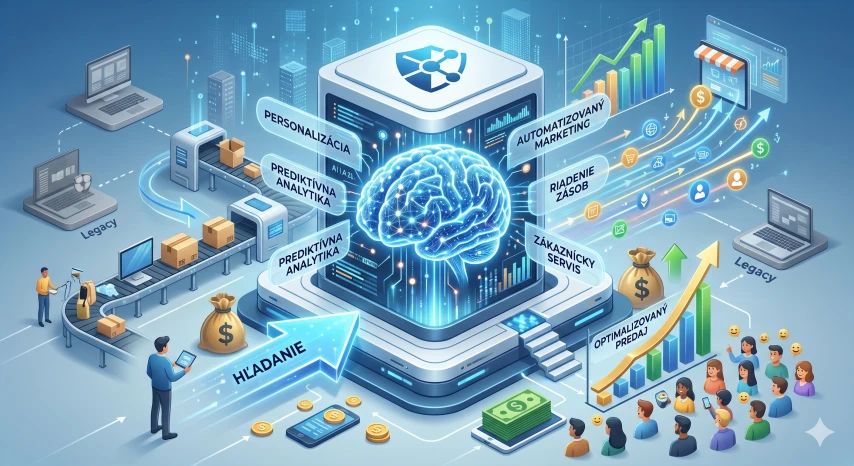
Based on current trends and predictions for 2025, we can identify several key AI solutions that will have a major impact on e-shops:
Hyperpersonalization
The article was revised and updated in May 2026.
AI will enable e-shops to provide an unprecedented level of personalization:
- Analysis of large amounts of data on customer behavior, purchase and browsing history
- Creating hyper-personalized offers, e-mails and landing pages
- Dynamic website content that adapts to shopper preferences in real time
Up to 91% of consumers prefer brands that provide relevant offers and recommendations.
Advanced chatbots and virtual assistants
- Ability to understand the context of the conversation and provide personalized support
- Answering questions, recommending products, tracking delivery and processing orders
- Continuous 24/7 customer support
AI-powered search and recommendations
- Sophisticated search and recommendation systems improving the relevance of results
- The ability to shop by style instead of a specific brand or category
- Personalized product recommendations based on preferences and purchase history
Predictive analysis and inventory optimization
- Predicting future shopping behavior and trends
- Supply chain optimization and inventory management
- Minimizing the risk of overstocking or selling out of products
Dynamic pricing
- Real-time price adjustment based on market conditions
- Analysis of large datasets for optimal pricing
- Adjustment of prices according to customer demand or competitor prices
Generative AI for content and marketing
- Automatic generation of product descriptions and marketing content
- Creation of personalized advertising campaigns
- Analysis of content trends to optimize marketing strategies
The implementation of these AI solutions will help e-shops increase sales, improve customer satisfaction, optimize operations and remain competitive in the rapidly changing digital environment of 2026.
AI agents in e-commerce
in 2026, AI agents are expected to play a key role in the transformation of online shopping. These advanced artificial intelligence systems are revolutionizing the way customers interact with e-stores and how stores optimize their operations.
Main functions of AI agents
- Personalized shopping assistants: AI agents analyze customer purchase history and preferences to provide highly personalized product recommendations.
- Task automation: The ability to independently browse websites, select products, and even complete purchases on behalf of customers.
- Inventory Optimization: Predictive analytics for effective inventory management and demand forecasting.
- Dynamic pricing: Automatic price adjustment based on market conditions and competition.
- Improved search: Implementation of voice and visual search for more intuitive shopping.
Benefits for e-shops
- Increase conversions and customer loyalty thanks to personalized recommendations.
- Streamlining operations and reducing costs through automation of routine tasks.
- Improving the customer experience by providing immediate and relevant support.
Challenges and the future
Despite promising prospects, AI agents face challenges in user privacy and efficiency. However, by 2026, AI agents are expected to be able to handle up to 20% of all e-commerce tasks, indicating their growing importance in the online retail industry. The implementation of AI agents in e-shops in 2026 will be key to maintaining competitiveness and providing superior shopping experiences to customers in a rapidly evolving digital environment.